October 21st, 2026
5 min read
What's inside Minerva's consumer data

We created Minerva to help companies understand the people behind their customer data, and act on what matters. One way we do this is by drawing on a licensed data set and proprietary consumer context graph.
Here’s what we cover, how we build it and where it comes from.
270M U.S. consumer profiles
500+ attributes per person, across 10 categories
4.6B+ linked identifiers in our identity graph
93% of profiles have at least 5 of the 10 categories filled
Since you and your biggest competitor can call the same AI models, your edge comes from what the model knows about the people you sell to. We've found that most companies know surprisingly little.
A CRM holds an email address and a purchase history, but that info won't tell you who the person is or how their life has changed since they first bought. Minerva’s data fills that gap.
An identity graph, with a profile on top
Consumer data has two layers, and you need both.
The first is identity. A person can show up as an email in one system and a phone number in another, at an address that may have changed twice since either was collected. Our identity graph links more than 4.6 billion identifiers back to the people they belong to, including more than 1.3 billion email links and 1.2 billion phone links. Each consumer resolves to one de-duplicated profile.
The second layer is the profile itself. Each one carries more than 500 attributes that describe how a person lives, grouped into 10 categories.
What the data covers
The categories include:
- Identity and contact. Name, postal address and address history, email and phone.
- Demographics and household. Age, household size and homeownership.
- Property and home. Home value, equity, mortgage details and property history.
- Income and wealth. Ranges estimated by our models. These are modeled estimates delivered as ranges, not anyone’s actual financial records.
- Professional. Title, employer, work history and education.
- Lifestyle and interests. What people spend their free time and attention on.
- Vehicle ownership. Make, model and year.
- Digital identity. Hashed emails and device IDs.
Coverage is highest on the fields that let you reach a person and understand their household, because we know that's what marketers need most.

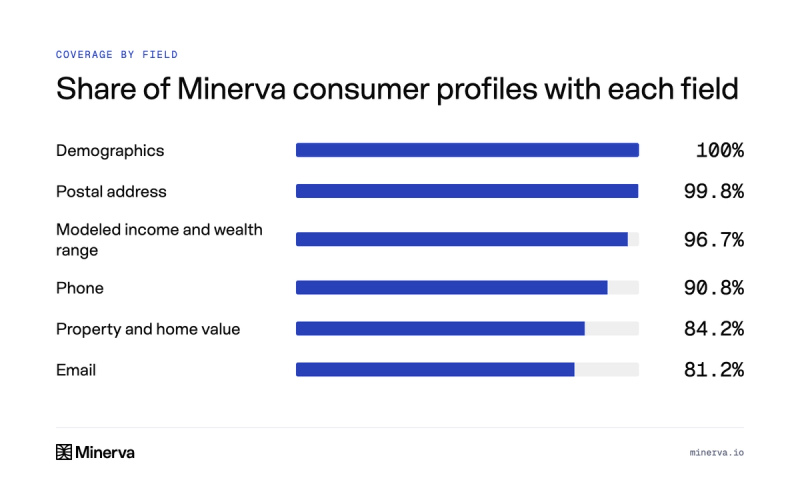
Share of Minerva consumer profiles with each field
Breadth matters as much as any single field. Most of our profiles carry several categories at once, so a household’s home, income range and contact points sit in the same record.
How deep it goes
A snapshot tells you where someone is today. History tells you what changed, and change often arrives right before a purchase. Someone who bought a home last month is a different customer than they were six months ago.
So we keep the history. Behind the current profiles sit 2.5 billion address-history records and 1.1 billion property-history records. Together they show when people moved and how the homes they own have changed hands and value over time.
The data also stays current. Property records refresh daily, and core identity refreshes monthly.
How we build it
The raw material comes from two places. We license data from established U.S. data providers, under contracts that permit our use of it. We add public records, such as property, deed and business filings.
Any company with a large enough budget can license the same data. The work that makes it useful happens after it arrives, in the identity graph Minerva built to assemble it.
Every source describes the same people differently. One has an old address and a landline. Another has a current mobile number and a work email. The graph links records across sources on hashed email, phone and address, then decides what each match means. When sources disagree about a person, it resolves the conflict. When two records turn out to be the same person, it merges them. When a record can’t be tied to a real person with confidence, it holds that record apart instead of forcing it into a profile. Each consumer ends up with one de-duplicated profile.
The graph also connects a person’s work identity to their personal one: a professional email and phone to the personal email, mobile number and home address of the same person. That link lets consumer marketing reach the people a B2B team already targets, at home.
Our models then add the income and wealth ranges described above.
When customers send us their own data for enrichment, we process it as a service provider and match it on hashed identifiers.
Sourced responsibly
Data about people comes with obligations. We treat them as part of the product, and buyers should ask every vendor about them.
- Minerva is a registered data broker and is enrolled in California’s Delete Request and Opt-out Platform (DROP).
- Consumers can access, delete or opt out of their data through our privacy center.
- Minerva has a SOC 2 Type 1 report, and the data is hosted in the U.S.
- Our data can’t be used for credit, employment, insurance or housing decisions. Minerva doesn’t provide consumer reports.
The data is kept in marketing and analytics, which is what it’s built for.
See it on your own customers
The best way to judge consumer data is to measure it against people you already know. Send us a sample of your customer file. We’ll show you which categories fill in, what the profiles look like and where the history adds something to your existing records.
If you’re building a product that needs to understand consumers, the same data is available through our API and MCP server.
Try Minerva now or talk to our team.
Good marketing starts with knowing who’s who.